Why the Spine’s Natural S-Shape Means Your Posture Doesn’t Need to Be Perfect

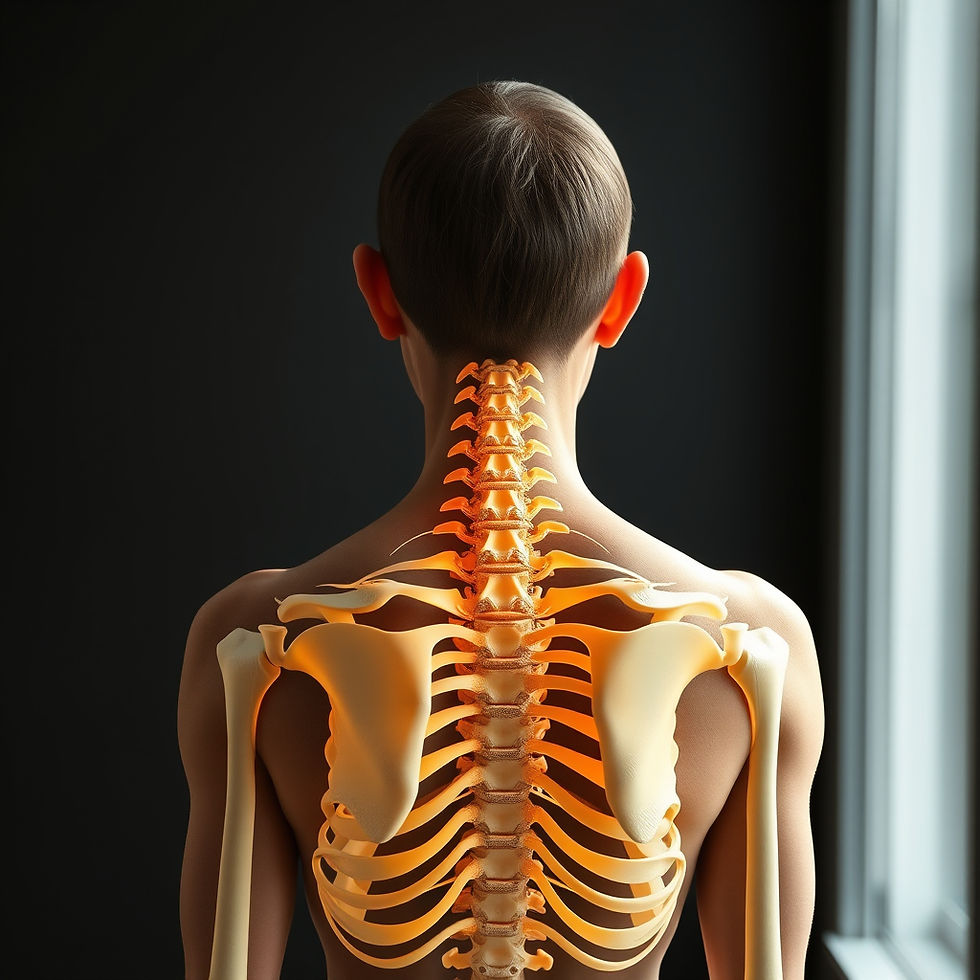
When most people think about “good posture,” they imagine a perfectly straight back and military-style shoulders pulled tightly backward. But the truth is much more human — and much kinder. Your spine is not designed to be straight. In fact, its natural S-shape is one of the biggest reasons why mild shoulder rounding or a slightly extended lower back can be completely normal.
Let’s break down what that means for your posture, your comfort, and your daily life.
Understanding the Spine’s S-Shape
From the side, the human spine forms an elegant S-curve with three key parts:
Cervical curve (neck) — curves inward
Thoracic curve (upper back) — curves outward
Lumbar curve (lower back) — curves inward
These curves exist for a reason: they help absorb shock, maintain balance, and allow the spine to move fluidly. In other words, the S-shape is functional, not a flaw.
Why Slightly Rounded Shoulders Can Be Normal
Many people worry about having “hunched” shoulders, but here’s the reality:
Your shoulder blades rest on the thoracic spine, which already curves outward. That means a slight forward rounding is a normal part of human anatomy — not necessarily a sign of bad posture.
A little rounding can:
reflect your natural bone and ribcage structure
reduce unnecessary tension from forcing a stiff, pulled-back posture
allow you to breathe and move more naturally
You’re not meant to stand like a statue. The upper-back curve is part of your design.
Why a Slightly Extended Lower Back Isn’t Automatically Bad
Just like the upper back, the lower back has a built-in curvature. The lumbar spine naturally curves inward, and how pronounced that curve is varies widely from person to person.
A mildly extended lower back can:
be part of your natural posture
provide shock absorption
support upright standing
reflect your pelvis shape or hip alignment
Trying to flatten this curve often creates more tension, not less.
Posture Is Dynamic — Not a Position You Must Hold

One of the most important things posture research has shown is that:
There is no single “perfect” posture that works for everyone.
What matters more than holding one ideal shape is the ability to move, switch positions, and feel comfortable. Your spine is built for adaptability, not perfection.
So When Is Slight Rounding or Extension Totally Fine?
Generally, your posture is perfectly okay if:
you aren’t in pain
you can freely move into other positions
you’re able to sit, stand, and exercise without limitation
you feel comfortable and relaxed
Your natural curves are doing exactly what they’re meant to do: supporting you.
Final Thoughts: Be Kind to Your Spine (and Yourself)
Your spine’s S-shape is a reminder that your body is beautifully designed for movement, flexibility, and everyday life. Slight rounding of the shoulders or a gently extended lower back isn’t something to “fix” — it may simply be part of who you are.
--Liam Hargis, M.OMSc


Comments