Why Would a Brand-New Baby Need Osteopathy?


“But they’re brand new… what could possibly be wrong?”
I hear this question all the time when people find out that a big part of my osteopathic practice is treating babies.
And honestly? It makes perfect sense.
We tend to think of osteopathy as something we need after years of sitting at a desk, playing sports, having injuries, carrying babies on one hip, or simply living life in a human body.
A newborn hasn't done any of that yet.
So why would they need osteopathy?
The answer is: they may not need treatment at all.
But being brand new doesn't mean their body hasn't already had quite the journey.
Pregnancy, birth, feeding, learning to move against gravity, digestion, sleep, head control and eventually rolling, sitting, crawling and walking all place new demands on a rapidly developing body.
Pediatric osteopathy gives us an opportunity to look at how that little body is adapting.
And sometimes, a wellness check is simply that.... a check.
Babies Are Brand New… But Their Bodies Aren't Blank Slates
Before your baby ever takes their first breath, they have spent months growing inside the uterus.
Toward the end of pregnancy, space becomes limited. Babies settle into different positions. Some stay head down for weeks. Others are breech or transverse. Some tuck themselves into one side of the uterus.
Then comes birth.
A vaginal birth, assisted birth, very fast delivery, prolonged labor, planned C-section and emergency C-section are all very different physical experiences.
Birth itself is a normal physiological process, and babies are wonderfully adaptable.
But every baby's experience is different.
Then suddenly, after birth, their body has an entirely new list of jobs.
Breathe. Feed. Swallow. Digest. Poop. Sleep. Regulate temperature. Turn their head. Move against gravity.
That's a pretty impressive first week of work.
A Baby Is Not a Tiny Adult
This is one of the most important things to understand about pediatric osteopathy.
A baby's anatomy is different.
Their body isn't simply a smaller version of ours, it is actively developing.
The Skull
A newborn's skull is made up of multiple bones that are not yet fused together.
The spaces where these bones meet - the sutures and fontanelles - allow the skull to accommodate birth and, importantly, the incredible amount of brain growth that occurs during infancy and childhood.
This is one reason I pay attention to head shape, head-turning preferences and neck mobility.
If a baby consistently prefers looking in one direction, for example, we want to understand why.
Is it simply preference?
Is there a limitation in neck movement?
Is positioning contributing to a change in head shape?
Is something else going on that needs to be assessed by another healthcare professional?
We're not trying to create a perfectly symmetrical baby.
We're looking at movement, comfort and development.
The Spine
A newborn's spine is also very different from an adult's.
Babies don't arrive with the same spinal curves we see in adults. Those curves develop progressively as babies begin lifting their head, sitting, standing and eventually walking.
Think about that for a moment.
A baby's body is literally changing its structure as it learns how to function in the world.
This is one of the things I find so fascinating about pediatric development, and it fits beautifully with one of the fundamental principles of osteopathy:
Structure and function are interconnected.
The Rib Cage and Diaphragm
A baby's rib cage is much more compliant than an adult's, and breathing mechanics are different too.
Babies rely heavily on their diaphragm for breathing.
And the diaphragm isn't something I think about only in relation to breathing.
It sits right in the middle of a very busy neighborhood.
Above it: the lungs and heart.
Below it: the abdominal organs.
It also works alongside the rib cage, abdominal wall and postural system.
This is why, when I'm assessing a baby, I may look at the ribs, diaphragm and abdomen together rather than treating each area as though it exists on its own.
And Then There's the Tummy
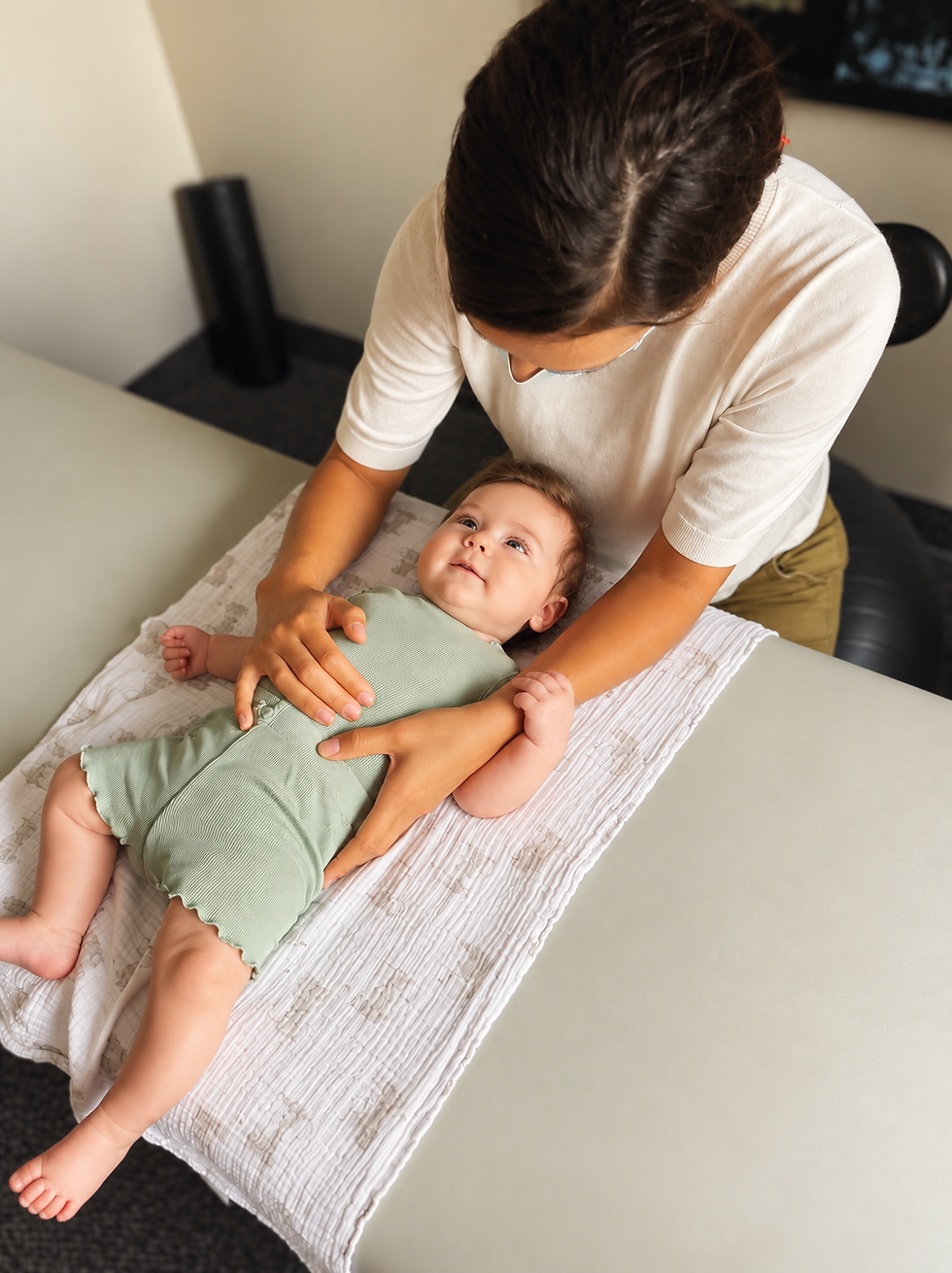
Parents often bring babies to me because they're concerned about gas, digestive discomfort, straining, reflux-like behaviors or general unsettledness.
A newborn's digestive system is adapting rapidly to life outside the womb.
Before birth, nutrition came through the placenta.
Now suddenly baby has to coordinate sucking, swallowing and breathing, move milk through the digestive tract and eliminate waste.
It's quite an upgrade to the operating system.
From an osteopathic perspective, I can assess things such as the movement of the rib cage, diaphragm, abdominal wall and surrounding musculoskeletal structures.
That doesn't mean every digestive symptom is caused by “tension,” nor does osteopathy replace medical care.
Persistent vomiting, poor weight gain, dehydration, blood in the stool, fever or other concerning symptoms need appropriate medical assessment.
Sometimes our role is not to treat.
Sometimes our role is to recognize that something doesn't fit the expected picture and refer.
That's an important part of pediatric care.
Feeding Is a Whole-Body Activity
Feeding is another area where parents are often surprised by how much anatomy is involved.
Whether a baby is breastfeeding, bottle feeding or doing a combination of both, feeding requires coordination between the tongue, jaw, lips, throat, neck, breathing and nervous system.

Position matters too.
Sometimes a parent will tell me:
"Baby feeds beautifully on one side but really struggles on the other."
That immediately makes me curious.
How does baby turn their head?
How is their neck moving?
What is happening through the jaw?
How are they positioning their body?
How are they breathing during the feed?
Rather than looking only at the mouth, pediatric osteopathy encourages us to step back and look at the whole little human attached to that mouth.
What About Sleep?
Ahhh… sleep.
Possibly the word every new parent simultaneously dreams about and fears discussing.
Newborn sleep is supposed to be irregular. Babies are biologically designed to wake frequently, particularly in the early months.
Osteopathy isn't about making a six-week-old “sleep through the night.”
But sleep and comfort do intersect.
Sometimes parents notice their baby seems uncomfortable lying in certain positions, consistently turns their head one way, arches frequently or has difficulty settling.
During an assessment, I may look at some of the physical pieces that can influence comfort: neck and rib-cage mobility, breathing mechanics, feeding, abdominal comfort and positioning.
And sometimes?
Everything looks perfectly appropriate for baby's age.
Reassuring an exhausted parent that what they're seeing is developmentally normal can be just as valuable as treatment.
The Nervous System Is Learning Too
A baby's nervous system is developing at an incredible pace.
Breathing, digestion, heart rate, feeding, sleep-wake cycles and regulation involve complex communication between the brain, autonomic nervous system and the rest of the body.
The vagus nerve is one part of that system.
You may have heard a lot about the vagus nerve & especially on social media... but it isn't a magical on/off switch that we simply “release.”
In pediatric osteopathy, I prefer to look at the bigger picture.
How is baby breathing?
How are they feeding?
How easily can they move?
How comfortable are they in different positions?
How are they interacting with their environment?
The nervous system and musculoskeletal system don't live in separate boxes. They're constantly communicating.
Milestones Change the Body
This is one of the reasons I love the idea of osteopathic wellness checks around developmental milestones.
Consider how much changes during baby's first year:
Head control → tummy time → reaching → rolling → sitting → crawling → pulling to stand → cruising → walking

Every new skill creates new forces through the body.
Before babies are standing, they aren't weight-bearing through their legs the way older children and adults do.
Then suddenly they're pulling themselves onto furniture.
Then standing.
Then taking those first wobbly little steps.
The body I assess at six weeks is functionally very different from the body I assess at six months or twelve months.
A milestone check can give us an opportunity to look at how baby is using their body as those new skills emerge.
Are they using both sides?
Are they comfortable moving in different directions?
Are they progressing in a way that makes sense for their developmental stage?
It isn't about rushing milestones or expecting every baby to follow an identical timeline.
Development has variation.
We're looking at the overall pattern.
So What Am I Actually Looking at During a Baby's Appointment?
When a baby is on my treatment table, or sometimes on Mom or Dad because that's where they're happiest! I'm observing much more than one symptom.
I may look at:
Head shape and head-turning preferences
Neck and spinal mobility
Rib-cage movement and breathing mechanics
Jaw and oral mechanics related to feeding
Shoulder and upper-body movement
Diaphragmatic and abdominal movement
Pelvis and hip mobility
How baby moves their arms and legs
How they respond to tummy time or different positions
Age-appropriate movement and developmental milestones
Overall symmetry, comfort and adaptability
And I'm watching baby throughout the entire appointment.
How they move.
How they breathe.
How they feed.
How they settle.
How they respond to touch.
Sometimes those observations tell us just as much as what my hands feel.
Does Every Baby Need Osteopathy?
No.
And I think that's important to say.
My goal isn't to find a problem in every baby who comes through my door.
Babies don't need perfectly symmetrical bodies.
Every preference doesn't need to be “corrected.”
Every episode of gas isn't a dysfunction.
And every difficult night isn't something that needs treatment.
Sometimes I assess a baby and think:
This little body is doing beautifully.
That's a wonderful appointment.
Other times, we find an area where baby isn't moving as comfortably or freely as expected. We may use gentle manual treatment, give parents positioning or movement ideas to try at home, and reassess as baby develops.
And occasionally I see something that tells me another healthcare professional should be involved.
Knowing when not to treat is just as important as knowing how to treat.
Not Every Osteopathic Practitioner Treats Babies
This is another really important piece for parents to understand.
Just because someone practices osteopathic manual therapy does not necessarily mean they have extensive education or clinical experience working with newborns and infants.
Pediatric osteopathy requires additional knowledge.
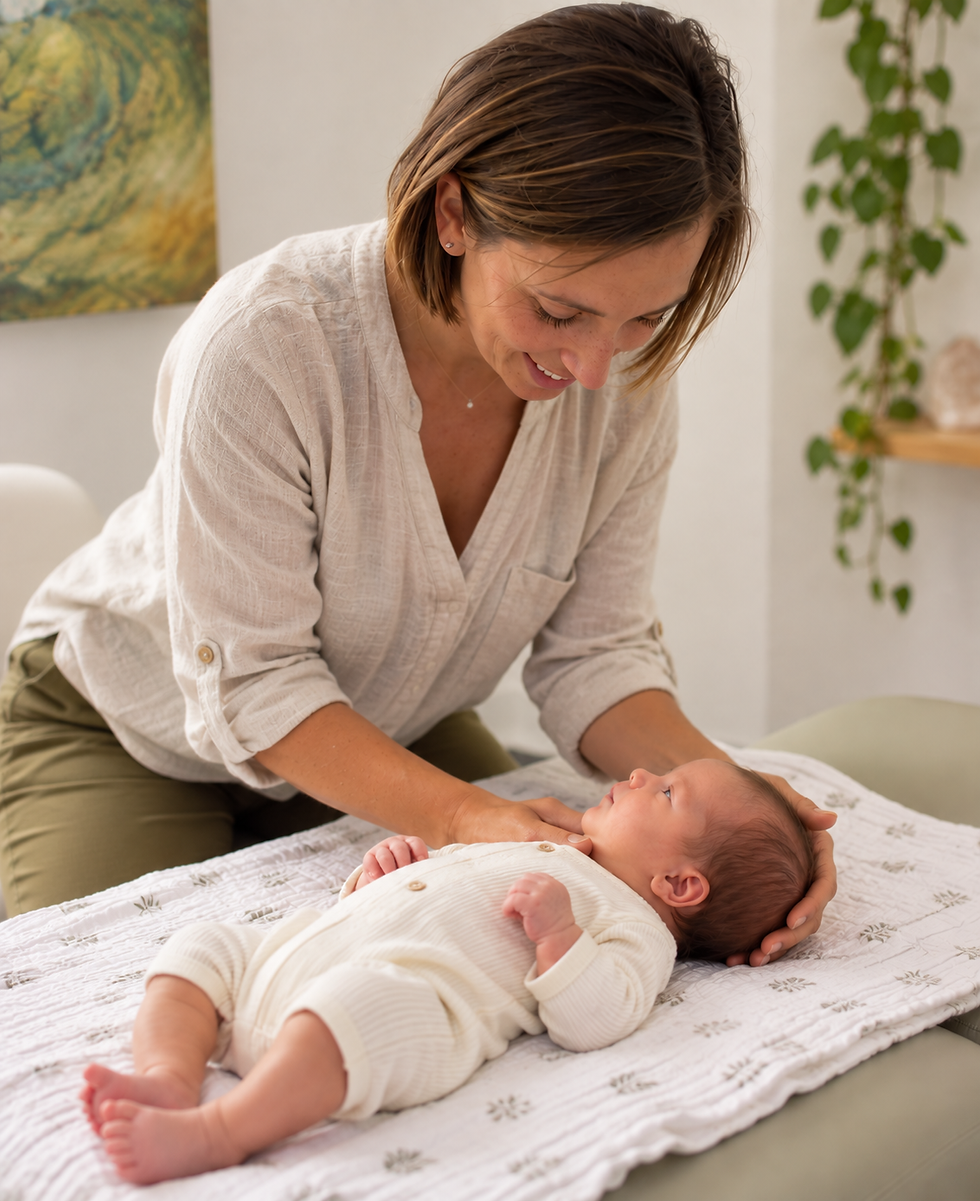
Babies have different anatomy, physiology and developmental needs.
A practitioner working with babies should understand pediatric anatomy, normal infant development, developmental milestones, feeding mechanics, head shape and positioning, as well as red flags and when to refer to a physician, lactation consultant, physiotherapist or another appropriate healthcare professional.
The techniques themselves should also be appropriate for a baby's age and developing anatomy.
We don't treat babies like miniature adults.
Because they aren't.
Setting Them Up for Success
For me, pediatric osteopathy isn't about searching for everything that could possibly be “wrong” with a baby.
It's about supporting the body during an extraordinary period of growth and change.
Sometimes families come because they have a specific concern.
Sometimes they come after a difficult birth.
Sometimes feeding feels challenging.
Sometimes baby strongly prefers one side.
Sometimes tummy time is everyone's least favorite part of the day.
And sometimes parents simply want a pediatric wellness assessment to make sure things are developing as expected.
All of those are valid reasons to ask questions.
Because those first months aren't just about growing bigger.
Your baby's brain, skull, spine, muscles, nervous system and movement patterns are developing together... each new experience helping prepare them for the next one.
We aren't trying to create a perfect baby.
We're giving that little body space to move, adapt and develop, and giving parents a better understanding of the amazing little human growing right in front of them.
They may be brand new.
But they've already been on quite the journey.
And they're only just getting started.
-- Vero Osteo


Comments